
How to remove Desktop Defender 2010?
What is Desktop Defender 2010?
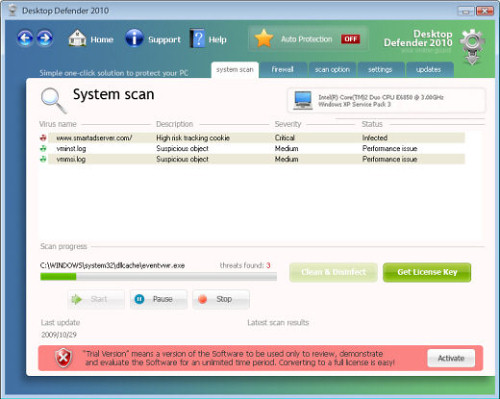
Desktop Defender 2010 is a fake and malicious anti-spyware program, which requires the help of reputable security software to remove. This rogue performs fake system scans and “informs” the user of a great number of infections on the system. This misleading information comes in other forms as well, such as popups and fake system notifications, which Desktop Defender 2010 floods the user with. Desktop Defender 2010 urges the user to purchase it’s “full version” in order to dispose of the threats, but this thing costs money and doesn’t really work. If nothing is done in order to dispose of this parasite, it might endanger the privacy of the user, the consequences of which can be dire indeed.
Desktop Defender 2010 rogue anti-spyware was created by the scammers responsible for releasing many other famous parasites, such as Contraviro and Unvirex. These two programs use a similar GUI and offer the same lack of services to the user. Desktop Defender 2010 is promoted on windesktopdefender.com and other fraudulent websites, where this malware can be downloaded manually. This is not the main route of infection however – Desktop Defender 2010 typically uses downloader trojans to infect systems. Once the system is infected, Desktop Defender 2010 changes some of the system parameters in order to be able to load at startup. Do not fall for these intimidating tactics. Use a reputable anti-spyware to fix your machine by removing all the files connected to Desktop Defender 2010.
Desktop Defender 2010 is Extremely dangerous
Desktop Defender 2010 is a corrupt Anti-Spyware program
Desktop Defender 2010 may spread via Trojans
Desktop Defender 2010 may display fake security messages
Desktop Defender 2010 may install additional spyware to your computer
Desktop Defender 2010 may repair its files, spread or update by itself
Desktop Defender 2010 violates your privacy and compromises your security
for Desktop Defender 2010 detection
Note: Spyhunter trial provides detection of parasite like Desktop Defender 2010 and assists in its removal for free. You can remove detected files, processes and registry entries yourself or purchase a full version.
Desktop Defender 2010 screenshots

Manual Desktop Defender 2010 removal
Important Note: Although it is possible to manually remove Desktop Defender 2010, such activity can permanently damage your system if any mistakes are made in the process, as advanced spyware parasites are able to automatically repair themselves if not completely removed. Thus, manual spyware removal is recommended for experienced users only, such as IT specialists or highly qualified system administrators. For other users, we recommend using Spyhunter or other malware and spyware removal applications found on 2-viruses.com.
Stop these Desktop Defender 2010 processes:
Disable these Desktop Defender 2010 DLL files::
Remove these Desktop Defender 2010 Registry Entries:
Remove these Desktop Defender 2010 files:
It is impossible to list all file names and locations of modern parasites. You can identify remaining parasites, other Desktop Defender 2010 infected files and get help in Desktop Defender 2010 removal by using free Spyhunter scanner. It comes with free real-time protection module that helps preventing Desktop Defender 2010 and similar threats.
Desktop Defender 2010 is classified as Rogue Anti-Spyware. After infecting a user’s system, it proceeds to scare its victim into buying the “product” by displaying fake security messages, stating that your computer is infected with spyware and only Desktop Defender 2010 can help you to remove it after you download the trial version. As soon as the victim downloads Desktop Defender 2010 trial version, it pretends to scan your computer and shows a grossly exaggerated amount of non-existent errors. Then, Desktop Defender 2010 offers to buy the full version to fix these false errors. If the user agrees, Desktop Defender 2010 does not only fix the errors, but it also takes the user’s money and may even install additional spyware into the victim’s computer.
Some Rogue Anti-Spyware, such as Desktop Defender 2010, may offer users to buy it after the victim clicks on a banner or a pop-up while surfing the internet. Usually, a Trojan is installed to a victim’s computer after clicking on the advertisement. It then proceeds to download or even install Desktop Defender 2010, which is another way for Rogue Anti-Spyware to spread itself.
Most of rogue Anti-Spyware, such as Desktop Defender 2010, is nearly impossible to remove manually.

Go Back in Time before your system was infected by this Trojan by using SYSTEM RESTORE!
Here is how for XP users, but VISTA users have similar instructions.
1. Click Start.
2. Point to All Programs.
3. Point to Accessories.
4. Point to System Tools.
5. Click System Restore.
6. Follow the instructions on the wizard.
This will not erase any photos or files you have created, it just takes your system back to a time when the virus was not there.
http://www.microsoft.com/windowsxp/using/helpandsupport/learnmore/systemrestore.mspx
http://windows.microsoft.com/en-US/windows-vista/What-is-System-Restore