
Home > Rogue Anti-Spyware > Additional Guard

How to remove Additional Guard?

November 23rd, 2009

What is Additional Guard?

Additional Guard sounds like the kind of program, which you might use just to make absolutely sure that your cyber security can not be compromised.  Well, if you thought that – surprise! Additional Guard is no more than a fake security program, which uses illicit methods both to spread and to sell. This parasite is a clone of Windows System Defender, and is every which way identical to it’s predecessor: it uses trojans to enter the system, and relies on misleading information to trick users into purchasing it’s “full version”.

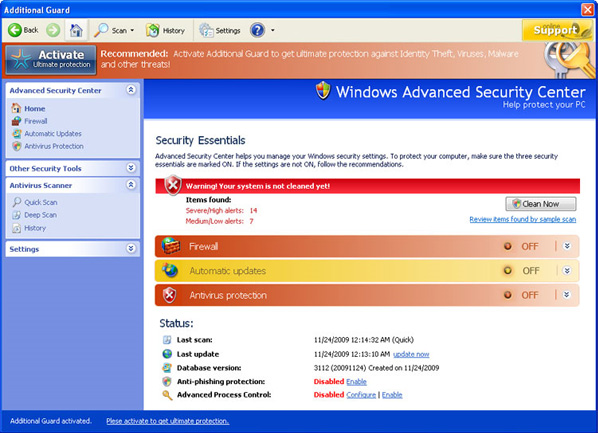
Once inside, Additional Guard will try to fool you by displaying annoying popups, which claim your system is infected, and urge you to protect your system using this program in particular. Then there’s the absolute classic, which is the fake system scan. This thing seems honest enough, and has a status bar – what more does an antivirus need? Rhetorical though that question may be, i would like to answer it anyway; what a decent antivirus needs – besides a status bar – is the ability to detect parasites,- something that is clearly not the greatest part of Additional Guard.

In a nutshell, Additional Guard is like paying money to get screwed over – do NOT trust it, and dispose of it as soon as possible.


Additional Guard is Extremely dangerous

arrow Additional Guard is a corrupt Anti-Spyware program
arrow Additional Guard may spread via Trojans
arrow Additional Guard may display fake security messages
arrow Additional Guard may install additional spyware to your computer
arrow Additional Guard may repair its files, spread or update by itself
arrow Additional Guard violates your privacy and compromises your security

Additional Guard screenshots


additional guard rogue anti-spyware

Manual Additional Guard removal


Important Note: Although it is possible to manually remove Additional Guard, such activity can permanently damage your system if any mistakes are made in the process, as advanced spyware parasites are able to automatically repair themselves if not completely removed. Thus, manual spyware removal is recommended for experienced users only, such as IT specialists or highly qualified system administrators. For other users, we recommend using automatic spyware removal applications found on 2-viruses.com.

Stop these Additional Guard processes:
Disable these Additional Guard DLL files::
Remove these Additional Guard Registry Entries:
Remove these Additional Guard files:

Additional Guard is classified as Rogue Anti-Spyware. After infecting a user’s system, it proceeds to scare its victim into buying the “product” by displaying fake security messages, stating that your computer is infected with spyware and only Additional Guard can help you to remove it after you download the trial version. As soon as the victim downloads Additional Guard trial version, it pretends to scan your computer and shows a grossly exaggerated amount of non-existent errors. Then, Additional Guard offers to buy the full version to fix these false errors. If the user agrees, Additional Guard does not only fix the errors, but it also takes the user’s money and may even install additional spyware into the victim’s computer.

Some Rogue Anti-Spyware, such as Additional Guard, may offer users to buy it after the victim clicks on a banner or a pop-up while surfing the internet. Usually, a Trojan is installed to a victim’s computer after clicking on the advertisement. It then proceeds to download or even install Additional Guard, which is another way for Rogue Anti-Spyware to spread itself.

Most of rogue Anti-Spyware, such as Additional Guard, is nearly impossible to remove manually.


How to tell if your PC has been infected by a Rogue Anti-Spyware such as Additional Guard?

Numerous undesirable and annoying pop-ups: A typical Rogue Anti-Spyware parasite keeps track of your internet browsing habits, sending your browsing history data to remote servers, owned by third party companies that use this information to advertise their products via numerous pop-ups, toolbars, hijacked homepages and spam letters. All these undesirable advertising methods are used on the victims of Rogue Anti-Spyware.
Changed or new icons: Sometimes, Rogue Anti-Spyware installs unwanted software to a victim’s PC without user’s knowledge and consent. This may lead to slower PC performance and stability, as well as more unwanted programs you can't remove.

Rogue Anti-Spyware

  1. No comments yet.
  1. No trackbacks yet.